Wednesday, 19 January 2011

Colour from the Season - Primrose pink?


The first primrose is flowering in the garden! In Devon primroses thrive - and soon the banks and hedgerows will be completely carpeted with them. Yes, primroses are usually yellow, but these pink hybrids occur naturally and range from the palest pinks like this one, to quite dark pink. Luckily our garden seems to get the full colour range...


...from my seasonal colour notebook.

Monday, 17 January 2011

Colour from the season - Rosa maigold

More thorny rose stems, this time from the beautiful old english climbing rose Maigold, which flowers in a wild and extravagant manner all through May on the front wall of our house. Interesting slightly ragged flowers and thorny stems, which were the inspiration for my fabric design Rosetta Glory...


 ...from my seasonal colour sample notebook.

Saturday, 15 January 2011

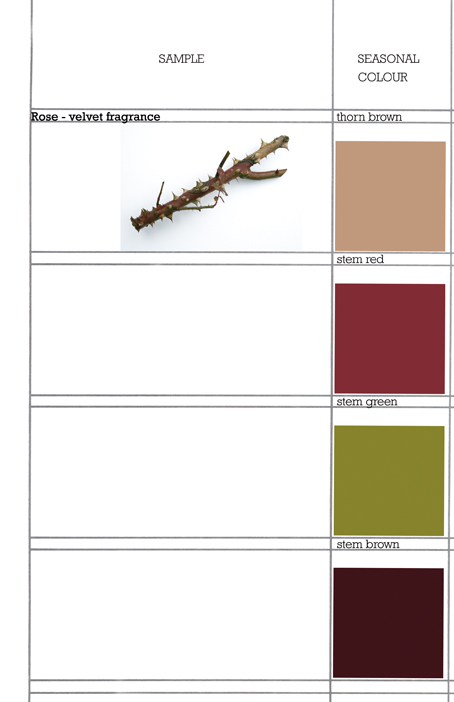
Colour from the season - Rose velvet fragrance

At this time of year you notice the stems of roses more than in the summer and often their names would seem inappropriate if you had never seem a rose bloom, this dangerously thorny one is called Velvet Fragrance. Roses always remind me of my mum - in the summer she has a garden full of amazing blooms. Though she had already pruned this one - she was ok about me taking off a bit more and luckily of course I have my new secateurs..x


...from my seasonal colour notebook.

Thursday, 13 January 2011

The little things - pocket sized secateurs

The little things in life that make the difference...


Mini secateurs - easier to make a quick getaway and much less damaging to the plants, which benefit from a little bit of pruning here and there anyway. I made a little holster for these because they're pretty sharp  - Perfect! 

(They're by Alan Titchmarsh)

Tuesday, 4 January 2011

Colour from the Season - Sarcococca

Berries turning right through these shades of red and purple to black and acid green leaves - For the January catwalk, this little moth I scouted out the other night, is wearing Sarcococca...


...from my seasonal colour notebook.

Sunday, 2 January 2011

Colour from the Season - Horse Chestnut bud red

Hard to believe after the prolonged cold weather - that any new growth would be venturing out of the trees and ground - but this morning I noticed that the Horse Chestnuts were starting to bud and it seemed fitting to start a new year with new growth. The sticky red of the bud alongside the smooth brown and purple of its branch.


...from my seasonal colour sample notebook.

Tuesday, 28 December 2010

Colour from the Season - hazelnut and walnut brown

A couple of winter nut cases. The familiar colour of hazelnut brown and less familiar walnut shell brown (walnut is more commonly referenced as the colour of the wood) - here are the colour matches that I've sampled...


...from my seasonal colour notebook.

Thursday, 16 December 2010

Colour from the season - Hawthorn leaf brown

The winter leaves have turned shades of silver greys and browns. The understated Hawthorn leaves, which don't look much at first glance, are one of my favourite and were the inspiration for the design 'digital hawthorn (dancing leaves)' in 2009...


...from my seasonal colour sample notebook.

The little things - inaccurate time

The little things in life that make the difference...


...don't get me wrong - I love my computer! - I also love old clocks that run a bit slow, instead of the digital, exactly to the second time-keeping. This one only loses about half an hour a week - nothing much really.


Tuesday, 14 December 2010

Colour from the season - Pampas grass

Pampas grass - the very fashionable  architectural/ornamental grass hugely popular in the 80's -  which I just discovered some interesting facts about, and thought I'd share. 
It's indigenous to South America, is a fantastic animal feed, considered hugely invasive in some climates producing around one million seeds in it's lifetime and ...lastly (!) if you have one in your front garden it's a sign that you're a 'swinger' - oh and it's a lovely colour...


...from my seasonal colour notebook

Monday, 6 December 2010

Colour from the Season - Lichen Greens

I was lucky enough to be in Snowdownia this weekend amidst all the snow and ice there and surrounded by the most inspirational landscape. In this snowy landscape, the lichen looked even more other worldly, frosted onto the branches of the trees and on the ground below, so many different lichen and colour variations, here are just a few...


...from my seasonal colour sample notebook.

Friday, 19 November 2010

the little things - leading to one quite big thing...


"Learn to say 'Fuck You' to the world once in a while" - Sol LeWitt


I discovered this quote a few years ago when I first came across the blog of Boym partners inc. I thought it was a great quote on a very interesting blog and wondered where it was from.

A month or so ago, I attended an inspiring exhibition and seminar 'Material Actions' . One of the speakers, Charlotte Squire showed some images of the work of Eva Hesse and spoke briefly about the book these images were from.  A few days after the seminar I emailed her to ask for the title of the book, which she kindly gave me. It's out of print, but I managed to get a copy of it from New York via Abebooks. When the book arrived - I found a simple but evocative inscription inside -


A short way into the book on page 35, I discovered the Sol LeWitt quote above which was part of a letter written by him in 1965 to Eva Hesse, they were friends I discovered, and he was giving her some advice. It's a wonderful letter - and a strange coincidence.

...it's funny how sometimes good advice comes along just when you need it!


Tuesday, 2 November 2010

The little things - Dogs2


The little things in life that make the difference...


...coming across Studio Legohead's quirky dogs on an otherwise dull day a few weeks ago!!!


The little things - Dogs


The little things in life that make the difference...


 David Cleverly's wonderful ceramic sculpture of my special dog Mac who died a year ago.


Friday, 15 October 2010

The little things...Chrysanths


The little things in life that make the difference...


...the rich autumn colours and incredible smell of these late chrysanths grown locally & bought from South Molton market on the W.I. stall to brighten my workshop yesterday. It isn't really a scent with chrysanths - but that wonderful earthy/woody smell, hard to describe but there's nothing like it.  I love drawing them - all those petals are a real challenge!


Saturday, 9 October 2010

The little things...socket in the right place


The little things in life that make the difference...


...after 10 years wishing I had a socket over my print table - I finally got one installed.


Monday, 6 September 2010

Best of British!


Fantastic news on my return to the studio this weekend to discover that my laser etched 'Korc Square' tiles have been shortlisted for the British Design Awards 2010 in the Best British Pattern 2010 category !  So a big thank you to Elle Decoration for this!! ...also thanks to Bath Spa University for their Innovation Award which enabled me to develop the tiles from their fledgling state.


Cork is a remarkable material, practically impervious to moisture; it is also a poor conductor of electricity, sound and heat, resistant to most chemical substances and has very good durability. It is a sustainable product and the European cork forests are extremely beneficial to the earths eco-structure.  The cork industry is struggling because of the decline in use from the wine bottling industry and by giving cork a positive new image, my aim was to help promote the revival of this amazing wood.


Wednesday, 11 August 2010

Natural Dyes


Visiting Scotland a few weeks ago, the rocks were covered in lichen, the hills in heather and bracken and the woods in blaeberries (bilberries). It was spectacular to see this abundance of vegetable dyestuffs used traditionally in the dyeing of tartans and tweeds.

Crotal is the common name for the several species of lichen that grow on the rocks and which give the famous chestnut and reddy brown colours (and woody smell) used originally to make Harris Tweed. Ragweed was used to give orange hues...


...heather and bracken gave a green and yellow dyes, black dyes were produced from alder bark and dock roots, birch leaves and bog myrtle produced a dull yellow and peat soot produced yellowy browns. Alongside the indigenous dyes, Indigo and madder were imported for shades of blue and red.

The scoured yarn was usually mordanted before dyeing and in the past mordants would have come from natural sources; rock alum, iron rich mud and other mineral deposits such as iron and copper sulphides.  An alkali or acid would also be added to the dye vat to help absorption of the dye to the fibre and in the past stale urine, tannins, wood ash, citric and oxalic acids (such as crab apple and rhubarb) were used for this.


                                                                                                 Lichen, heather, birch leaves and oak galls


Two of the best recipe books I have found for dyeing with natural dyes are 'Natural Dyes - Fast or Fugitive and Natural Dyes for Vegetable Fibres, both by Gill Dalby and available along with a vast range of natural dyes from P and M Woolcraft .

For block printing recipes, indigo vats and interesting (and archaic!) dye recipes - Susan Boscence's book 'Hand block printing and Resist dyeing' is very informative. Some of the ingredients are difficult or impossible to source nowadays or are simply too poisonous to consider using. I found that dyeing fabrics in iron rust and printing with print pastes made up with solutions of oak galls and other plants high in natural tannins effective and interesting (although limiting in colour).  Here's an interesting indigo recipe from her book...

RECIPE

"a very old Shetland recipe used for fisher folks' jerseys which was guaranteed absolutely fast:

Preserve a gallon of urine for over a fortnight (male urine is best) preferably in a warm place, stir occasionally, and in this soak one and a half ounces powdered indigo tied in a muslin cloth. Soak wool in warm urine for ten minutes before putting in the tub - which should be kept warm and stirred occasionally, it takes two weeks to get a good blue" 


Below some of my dye notes recording natural dye and print recipes and colours on Hemp, Cotton and Silk...


... even the limpets in Scotland reminded me of pleated tartan?


Tuesday, 25 May 2010

Trays


There's nothing I enjoy more than learning about technical processes, so it was really exciting in March this year to have a wonderful opportunity to visit a tray manufacturer in Sweden to put some of my designs onto trays.
The trays are constructed from multiple sheets of laminated birch wood sourced from sustainable forests - with a melamine coating as the top laminate they are very strong and have an exceptionally high quality of finish.


Prior to manufacture, every sheet of birch wood is checked for quality. The sheets are then laminated and pressed using wooden and metal embossing presses and moulded into the many and variable tray shapes and sizes. It's still very much a hands on process using traditional craftsmanship and the trays are manufactured in very much the same way as they were 60 years or so ago, although much of the printing of the surface design is now processed digitally and not lithographically.


My tray designs which include Rosetta Glory (top), Geotaxis, Spiral, Cork and Dahlia & Chrysanths (below) will be launched in two weeks time at Pulse 2010, London!


finally a few cut outs of my personal favourite Geotaxis...!


If you would like further information about the tray collection contact Joakim Sohlberg at Ary Trays.


Sunday, 29 November 2009

Block Printing


A few weeks ago I visited a number of wallpaper and fabric factory's in the north of England. It was very interesting to see the many different printing machines and processes, but one of the highlights was seeing the original wood blocks of William Morris, along with the simplistic, wallpaper printing machine (below), which these blocks are still sometimes printed on today. The image above, shows the block from the design 'Larkspur'. This was the monochrome version designed by Morris in 1872 and cut into pearwood. Here the block is composed only of wood, but for some of the more intricately patterned blocks, metal was used as well as, and later in place of wood. Below is a block from his design 'Apple' (1877)  showing this intricate metal detailing.

the foot operated wallpaper printing machine...


My interest in block printing originated during my degree in printed textiles at Camberwell School of Art and Crafts (as it was then) in London between 1982-5. Here we were taught traditional print skills such as block and screen printing. Allowed only to use black and white for our entire first year, while learning to stretch screens, mix dyes, cut blocks, dye yarns and fabrics, thread simple warps etc. The emphasis primarily, was placed very much on developing skill both in craft and in drawing. Only in the second year did this lead into an introduction and practical study of colour. Reminiscing about this recently - I remembered how fed up we felt at the time to not be able to use colour and it was only much later that I could appreciate the discipline of using black and white to learn the value of tone, contrast, texture and line.

One of our visiting lecturers was the textile printer Susan Bosense. Encouraged to start printing herself through her connection and friendship with Dorothy Barron and Phyllis Larcher, two leading British hand block printers working in the 1920's and 1930's, she in turn, inspired and encouraged many textile designers to set up their workshop and start printing.  Her invaluable book 'Hand Block Printing and Resist Dyeing' was published by David and Charles in 1985.

It is not really surprising, that when, during my final year, I won a Royal Society of Arts travel award, I decided to spend one year in India studying wood block printing. Initially, I spent time at various block printing factories outside Delhi, later I travelled off the tourist trail, to places, such as Barmer in Rajasthan to study the specialized block printing traditions of these towns, which were often incredibly basic.  In Barmer (vegetable Azarakh printing), I witnessed block printing using boards which were placed on the printers lap as he sat on the ground,  the fabric dried quickly in the sun and the metreage of fabric was passed along the board as the fabrics were printed. Often, as I recall, three or four colours were printed in this way!

Barron and Larcher and Susan Bosence's fabulous block printed fabric books were originally kept at the Holburne of Mentrie Museum in Bath, where I first saw them in the 1990's. Today these inspirational collections are held at the Crafts Study Centre in Farnham and well worth a visit!

(below, a detail from one of my own lino cuts - 'Chrysanths')